
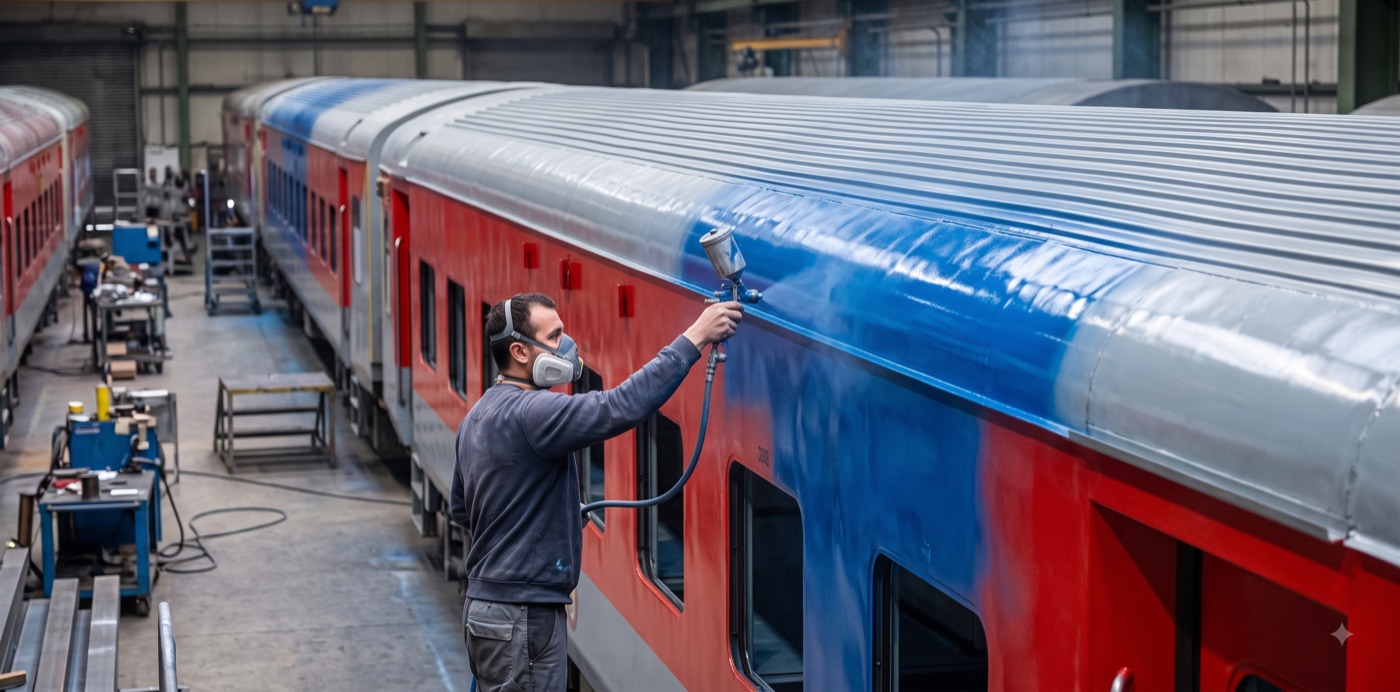
RDSO Approved Railway Coatings: What Makes Them Different?
Indian Railways operates over 70,000 coaches across one of the world's largest rail networks. These coaches face extreme conditions — tropical UV, monsoon rains, temperature swings from 5°C to 50°C, stone chipping from ballast, chemical cleaning agents, and constant passenger use.
Why Railway Coatings Are Different
A railway coach coating must simultaneously provide:
Corrosion protection — The steel shell must be protected for 8-12 years between workshop repaints.
Appearance — Gloss and colour must be retained despite years of UV exposure and chemical washing.
Fire safety — EN 45545 HL3 compliance is increasingly required. The coating must not contribute to fire spread or toxic smoke.
Mechanical durability — Resistance to stone impact from ballast, vibration, and regular cleaning.
The FEVE Advantage
FEVE (Fluoroethylene Vinyl Ether) fluoropolymer topcoats offer the highest weatherability available in a liquid coating. Unlike conventional polyurethane, FEVE resins contain carbon-fluorine bonds that are virtually unbreakable by UV radiation.
The result: gloss retention above 80% even after 10+ years of outdoor exposure, versus 40-50% for conventional PU.
Anupam's Railway Heritage
Anupam Paints has been supplying Indian Railways for over three decades. Our ANUTHANE FEVE system has been tested for over 4000 hours in QUV accelerated weathering and meets EN 45545 HL3 R7 fire safety requirements.
We supply coating systems to CLW, DMW, ICF, RCF, MCF, and multiple railway workshops across India.
Need Technical Assistance?
Our team can help you select the right coating system for your specific application.